
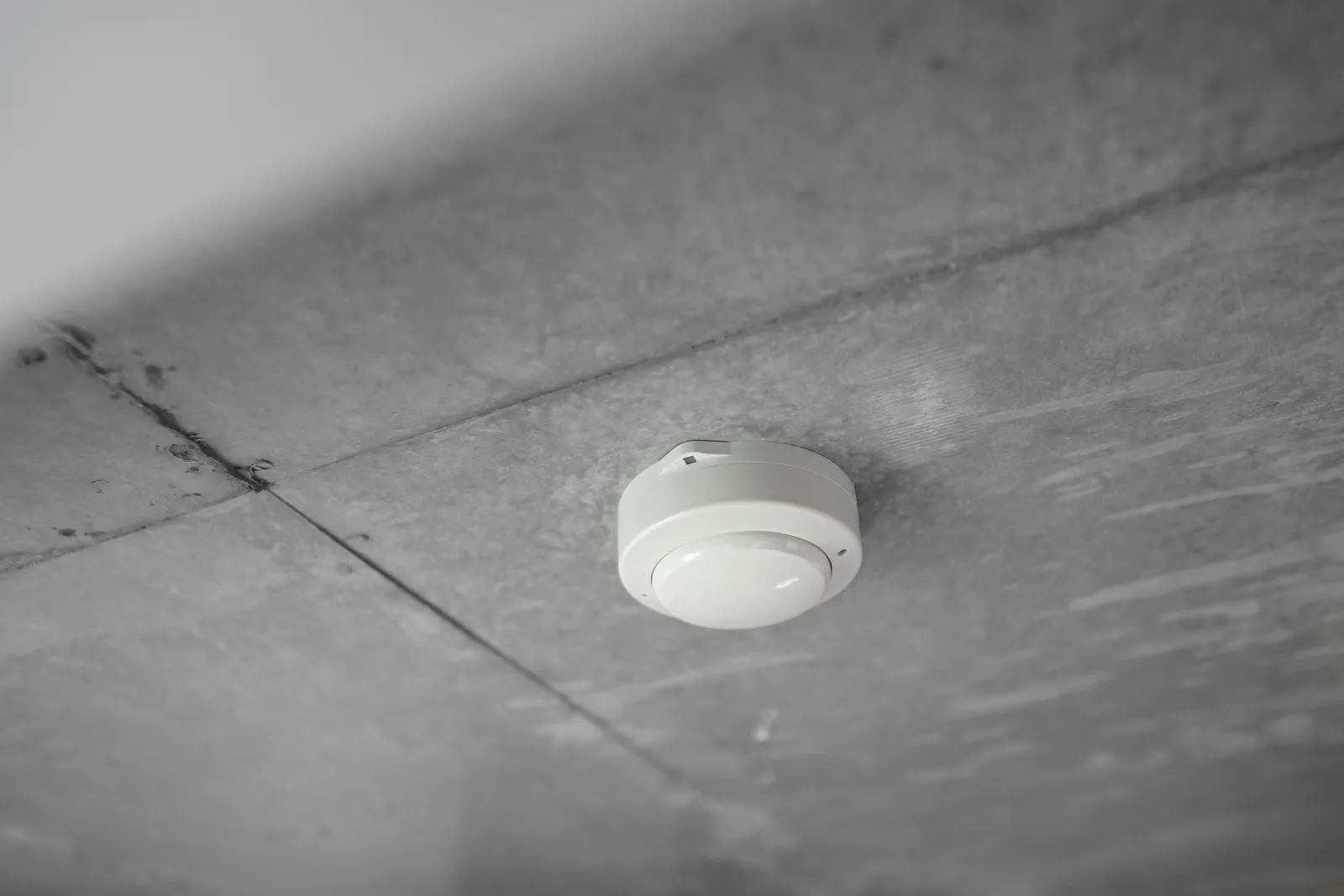
A fire alarm going off in the middle of the night is annoying, to say the least. But when a fire alarm keeps beeping, don’t ignore it, even if you suspect a false alarm. Find out everything to know about fire alarms, including how to turn off smoke alarms that keep going off, and how to check and replace a fire alarm battery.
Table of Contents
Why Does Fire Alarm Keep Going Off for No Reason?
There are a few possibilities as to why a fire alarm repeatedly activates, and if it keeps beeping, it requires attention. Common reasons a fire alarm keeps going off are:
- Dead or dying batteries.
- Poor placement, like in kitchens, bathrooms or garages.
- Interference from airborne chemical compounds, like those released from wet paint.
- Accumulation of dust and insects inside the alarm.
- Excessively high humidity.
Keep getting false alarms, but not sure why? Jump below for an in-depth exploration of the causes behind false alarms.
How to Turn Off Fire Alarms – 3 Ways
If there’s clearly no smoke, a smoke detector chirping or flashing red is a sign of a false alarm. How to turn off a fire alarm depends on the specific model, so always check the manual if you have it. If you have no idea where the manual is (or you’re currently in bed fighting for some shut-eye), follow the simple steps below.
1. Press and hold the hush button
Press and hold the hush button on the front panel of the alarm for at least 10 seconds. It’s usually the only visible button on the alarm, typically labeled ‘test’, ‘hush’, or ‘silence’. Holding the hush button for different lengths of time has different functions, so try holding for 30 seconds if 10 doesn’t stop it.
Credit: DIY-time Tech.
2. Flip the mains or replace the battery
Investigate the entire property for signs of a fire. If the smoke alarm that’s going off for no reason is hard-wired, try flipping the switch on the mains breaker box. Turn it back on after several seconds and observe. If the alarm runs on a battery instead, replace the old battery with a new one of the type the alarm specifies.
3. Reset the smoke alarm after replacing the battery
Once you’ve replaced the battery, reset the alarm. The beeping might continue even after replacing the battery, so if you’re wondering, ‘why does my smoke alarm keep going off even with a new battery?’, it’s likely that the alarm unit itself hasn’t actually reset.
5 Most Common Reasons for False Alarms
If false alarms happen frequently, get to the bottom of the cause below before replacing the device.
1. Dead fire alarm battery
The most common reason for a false alarm is a dead smoke detector battery. Without holding it, press the button on the front of the panel to test the battery. If the alarm sounds loudly and clearly, it’s good to go. If there is no sound, or the alarm is quiet, slurred, or bending in pitch, replace the battery.
Credit: Everyday Home Repairs.
2. Too close to the kitchen
The kitchen is by far the most likely place for a fire to break out, yet it isn’t advisable to put a smoke detector in the kitchen because cooking will regularly cause false alarms.
‘Don’t fit them in kitchens or bathrooms,’ says Mark Hazelton, Group Manager for Community Safety with the London Fire Brigade. ‘Do fit a heat detector in your kitchen.’
Rather than sounding when smoke cuts the electrical current, heat detectors sound when the temperature goes beyond a set threshold. Also install carbon monoxide detectors in kitchens.
3. Too close to the bathroom
Rising steam from hot water triggers smoke detectors, regardless of how ventilated the bathroom is. Not to mention, alarms aren’t usually waterproof, so moisture from steam damages circuitry.
Aside from that, when enjoying a candlelit bath, never leave the lit candle unattended and always remember to extinguish it before exiting the bathroom.
Credit: strategicfire.
4. Chemical compounds, insects, and dust
There are certain airborne chemical compounds that trigger a false alarm. If some redecorating has recently been done, for instance, there’s a chance that the compounds used to keep paint wet cause the electrical current in the detector to break.
Similarly, if the opening to the chamber is wide enough for bugs to crawl inside, they probably will. Insects and accumulations of dust interfere with both photoelectric and ionization smoke detectors, so take a look inside to see if it needs cleaning.
5. Faulty product
If the fire alarm keeps going off despite your best efforts, it’s time to buy a new one. While fire alarms should, in theory, undergo rigorous testing before being released, there’s a chance that a faulty fire alarm with a weak electrical current was purchased.
Fire alarms must be replaced every ten years, so if more than a decade’s passed since purchase, install a replacement as soon as possible.
Credit: S.E.R Safety.
Your Biggest Carbon Monoxide Concerns, Resolved
Plenty of confusion exists about fire alarms and related products, like carbon monoxide alarms. It’s not always obvious what carbon monoxide is or does, and what types of devices you even need to detect it in the first place. So, we’ve rounded up your biggest concerns about carbon monoxide to shed light on fire safety.
1. Do fire alarms go off for carbon monoxide?
‘Fire alarms’ are typically smoke detectors, meaning they detect smoke as it rises up and enters the device. Smoke detectors don’t detect carbon monoxide, which is an odorless, invisible gas. Find out what the four different types of fire alarm are here.
However, many new fire alarm devices have dual detection features, so if your alarm is a recent purchase, check online to see if it detects carbon monoxide as well as smoke.
2. How do I know if there’s carbon monoxide in my house?
Because it is odorless and invisible, the only reliable way to know if there’s carbon monoxide in the house is to install a carbon monoxide detector, which sounds when there’s dangerous levels of carbon monoxide in the air for a certain time. Every home with fuel-burning appliances, a fireplace or an attached garage should have carbon monoxide detectors to keep occupants safe.
3. How much carbon monoxide sets off alarm?
Carbon monoxide alarms sound based on both the level of carbon monoxide and how long it is detected in the air. Under the US UL 2034 standard, an alarm must not sound below 30 parts per million (PPM), and must sound within 60 to 240 minutes at 70 PPM. The higher the level, the faster it sounds.
At 400 PPM, an alarm must sound within 4 to 15 minutes. Requirements differ in other countries, so check the standard printed on your alarm.
4. Do carbon monoxide alarms need to be linked to smoke alarms?
No, carbon monoxide alarms don’t need to be linked to smoke alarms to be effective. In some areas of the house, like the kitchen, a heat detector is a better fit than a smoke alarm, which is prone to false alarms in kitchens. A carbon monoxide alarm does not detect fires, so it can’t replace either one.
What’s important is that the house has a mixture of smoke detectors and carbon monoxide alarms. Heat detectors are also a useful way to monitor fires.
5. What do carbon monoxide alarms sound like?
Carbon monoxide alarms usually beep excessively if they detect unsafe levels of CO in the atmosphere. Different models have different beeping patterns. A ‘low battery’ warning is usually a single beep every few minutes. If a carbon monoxide alarm sounds, get everyone outside into fresh air and call emergency services from there; don’t go back in until it has been declared safe.
Conclusion
With more than a quarter of reported fires occurring in the home, fire safety is super important if you want to improve the overall safety of the home. Combining smoke, heat, and carbon monoxide detection is necessary and provides peace of mind.
A fire alarm that keeps going off is a nuisance, but no home should ever go without a fire alarm, so do not remove the battery unless replacing it immediately.
Recommended reading: