
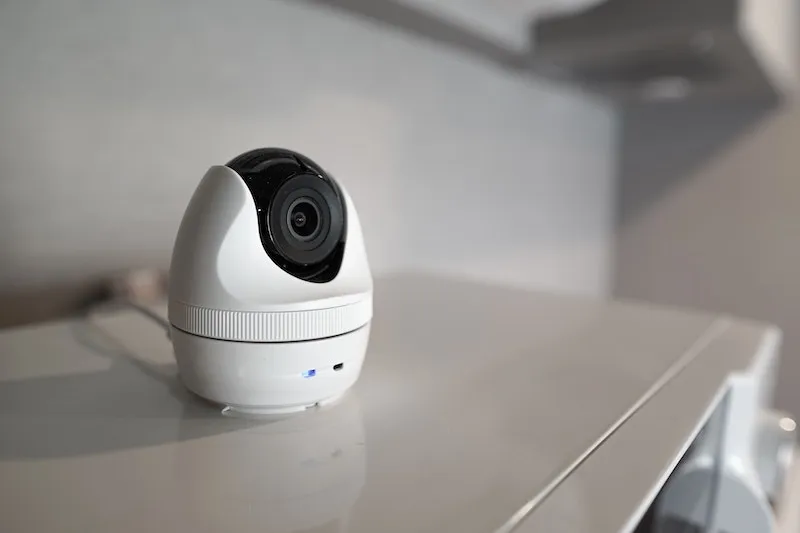
IP and HD analog cameras can both be used as home or business security cameras. The main difference between the two cameras lies in how footage is processed and stored.
Being the more modern solution, IP cameras offer more benefits to users than HD analog cameras.
In this article, we’ll explain the difference between IP vs HD analog cameras for your home or business place.
Table of Contents
What is an IP Camera?
Internet Protocol (IP) cameras are a modern type of security camera that capture footage, compress it, and transmit it via the internet. Wireless IP cameras usually use Wi-Fi to do this. Most commonly, the footage is stored in the Cloud or on an NVR (Network Video Recorder).
Some IP cameras, like AlfredCam, also allow for footage to be stored locally on a microSD card or on a paired phone’s onboard storage.
What is an HD Camera?
An HD camera means any camera that is High Definition (HD) in terms of picture resolution (i.e. quality).
A camera is considered HD if it has an image resolution between 720p and 1080p. Images are clearer and crisper the higher the resolution. So, cameras that support up to 1080p resolution (like AlfredCam) have better image quality than those that support 720p.
The night vision is wonderful, especially with the HD 1080P 130-degree wide-angle view. Truly it is even better to have 24/7 continuous recording nowadays. — One AlfredCam user
Cameras with image resolution lower than 720p are considered SD or Standard Definition cameras.
What is Analog CCTV?
Analog CCTV is a more traditional type of security camera. Because of the complexity of its installation and operations, it’s generally found in public places (like street footage) or on large business premises.
Unlike IP cameras, which transmit footage via the internet, analog CCTV cameras must be connected to a DVR before they can collate, compress, and store footage.
In practice, this means the camera needs to be hardwired and connected to a DVR. The recordings are accessed via the hard drive it’s saved on meaning they may need to be transferred to a USB flash drive to view on a computer.
Which is Better, IP or Analog CCTV?
Because IP cameras are a more modern solution, they are considered better than analog HD cameras for two main reasons: high image quality and convenient storage.
Firstly, IP cameras capture high-quality footage of what goes on around your home. Most home security cameras offer continuous 24/7 recording and/or motion detection recordings.
This means homeowners and businesses can access high-quality footage easily from any connected device, which makes them better for checking who is at the door or if an intruder is on the property.
Secondly, IP cameras are easier to set up and offer a more modern solution for storing, saving, and accessing footage. This makes it easier to check footage, save it, and share it with others.
For example, if a home security camera has picked up something funny a pet has done, it’s easy to review the footage and share it with other family members.
If an intruder is on the property, an instant push notification will tell the user motion has occurred, enabling the police to be called much faster.
What are the Benefits of IP Cameras Over Analog Cameras?
The main benefits of IP cameras over analog cameras are:
- Clear, crisp image quality
- Easy installation
- Access from anywhere
- Compatible with most devices
- Options for local storage and Cloud storage
- Secure and convenient
1. Better image quality
High-quality footage is important for any property or business. IP cameras are the more modern solution to protecting a property or business premise with security cameras.
Because the models are newer, image resolution is significantly higher, leading to better quality footage.
This is unlike the grainy, blurry footage often produced by analog CCTV cameras.
A good security camera should be able to pick up faces, clothing, color, and other details about what the intruder is doing. Otherwise, they are pointless and ineffective.
2. Safe, convenient storage of footage
Another key difference between IP cameras and analog CCTV cameras is the way each type of camera processes and stores footage.
As explained above, analog cameras can only store footage on a connected hard drive. This means adequate storage is always needed to prevent recordings from not saving, plus a “base” to view the footage.
IP cameras digitize footage so it can be stored locally or in the Cloud. When stored in the Cloud, the footage can be accessed anywhere, including a phone, tablet, or computer.
With most IP cameras (including AlfredCam), Cloud storage can be increased by upgrading to a monthly or yearly plan subscription. This enables businesses to easily record and save as much footage as needed.
3. Easier to install
Another benefit of IP cameras over HD analog cameras is that they are significantly easier to install.
IP cameras can be wireless cameras or connected to an ethernet cable. Wireless IP cameras operate on Wi-Fi and need to be plugged in (either on occasion to charge or permanently).
IP cameras are easier to install because they simply need to be connected to the internet and a regular power source, like a USB port or wall socket.
Analog CCTV must be connected to a closed-circuit hard drive to process, save, and store footage.
What is the Disadvantage of IP Cameras?
There are few disadvantages of IP cameras compared to analog CCTV. They are the more modern solution to home and business security.
The main disadvantages of IP cameras are:
- Can be slightly more costly than analog CCTV (although it’s possible to find affordable solutions, like AlfredCam)
- Require good internet bandwidth
Conclusion
The main difference between IP and HD cameras lies in how the cameras process, transmit, and store data.
IP cameras store and transmit data via the internet. Whereas analog HD cameras must be connected to a DVR before footage can be stored and viewed.